
ISARA’S PATHWAY · PHASE 1
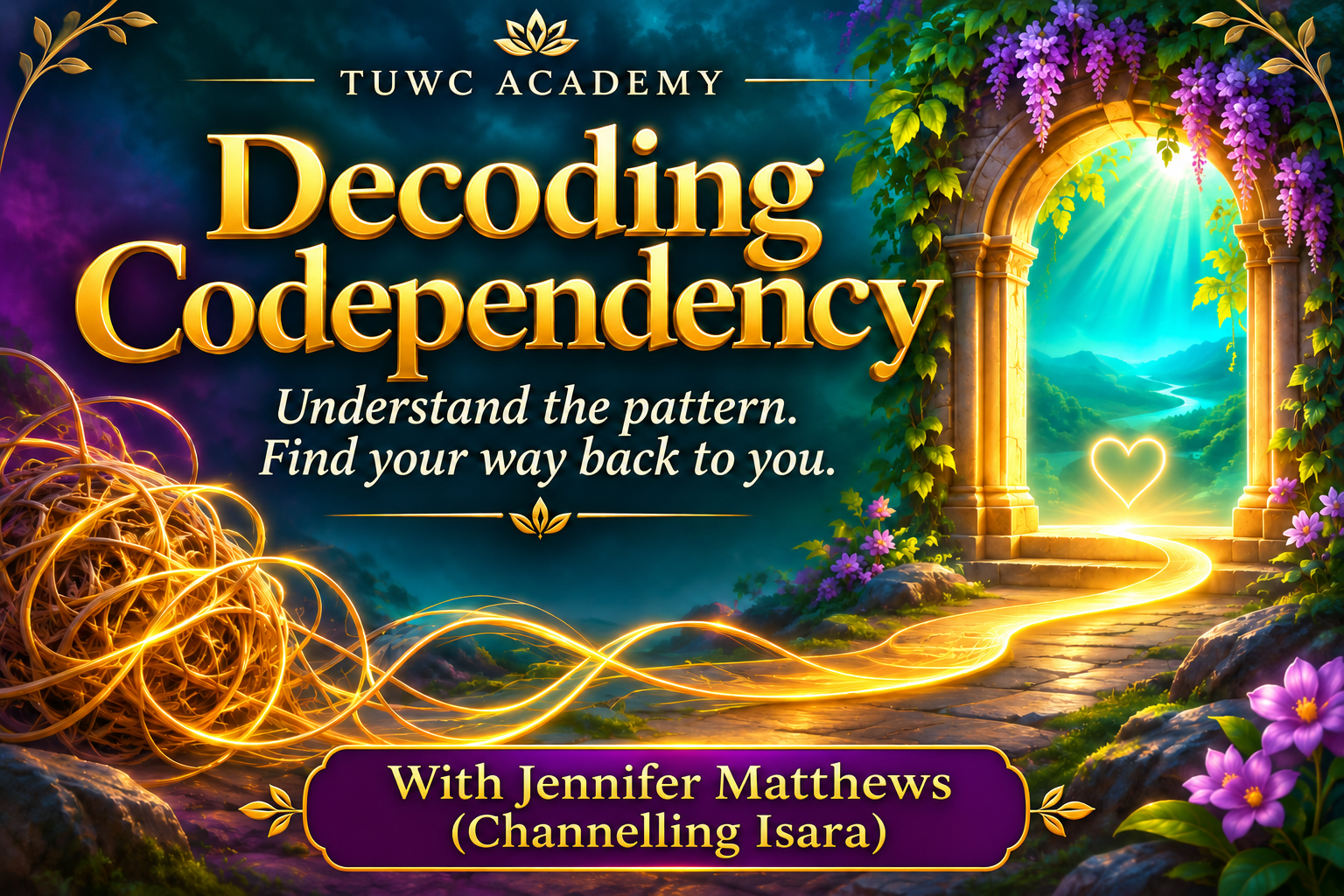
Decoding Codependency
You can love someone without making their whole world your responsibility.
But when you’re used to being the one who fixes things, keeps the peace and notices what everyone needs, it can be hard to see where caring ends and losing yourself begins.
In this course, I’ll help you make sense of what’s happening, recognise the moments you get pulled in, and find a small place to begin choosing differently. You can still be kind. You get to be included too.
With Jennifer Matthews (Channelling Isara)
5 modules · 15 lessons · 5 guided practices · Companion workbook
If you’re tired of being the one who holds everything together…
Perhaps you’ve been calling it ‘just being helpful’. But you’re exhausted, and somehow your own needs keep slipping to the bottom of the list. See if any of these feel familiar.
Their mood becomes your job.
Someone goes quiet and you’re already wondering what you did wrong—or what you can do to make things okay.
Your yes comes too quickly.
You agree to help before you’ve checked whether you have the time, energy or desire. Afterwards, you wish you’d stopped to think.
You’re there for everyone.
But when you need something, you struggle to ask. It feels easier to keep giving than risk letting someone down.
If you recognise yourself here, I want us to look at the pattern with some kindness. You don’t have to prove how bad things are to begin.
What could begin to feel different?
I want you to have something useful to reach for the next time you feel yourself getting pulled in.
‘I can see what’s happening.’
Instead of only knowing you feel drained, you’ll have a way to recognise what starts your cycle and why you keep stepping in.
‘I can give myself a moment.’
You’ll practise pausing before your automatic response, so you can check what you need and what you actually have to give.
‘I know what I need next.’
You’ll leave with your own pattern map and a clearer sense of which skill or support would help you move forward.
You may still have uncomfortable feelings. We’re working towards more awareness and choice, one everyday moment at a time.
Take a look at what you’ll gain, one module at a time.
Choose a module below. You’ll see how each lesson connects to something you may be dealing with, and what you’ll have to practise afterwards.
MODULE 1 OF 5
Recognise the Pattern
We’ll begin by making sense of what codependency can look like in an ordinary day. I don’t want you sitting here collecting another label to judge yourself with. I want you to be able to recognise a pattern and say, ‘Oh. That’s what I’ve been doing.’
What you’ll take from this module
Leave with clearer words for what you’re experiencing, without making yourself the problem.
Your three lessons
LESSON 1.1
What codependency means in everyday life
You’ll be able to name what is happening when someone else’s needs or reactions keep deciding your day. That can help you make sense of the exhaustion you haven’t quite been able to explain.
LESSON 1.2
Care, interdependence and self-abandonment
You’ll have a clearer way to tell when helping is a choice and when you’re leaving yourself out. You don’t need to stop caring to recognise that a situation is costing you too much.
LESSON 1.3
A pattern you learned—not your whole identity
You can begin looking at your responses without turning them into a verdict on who you are. That gives you somewhere kinder and more useful to begin.
Make it part of your day
Noticing Without Judging — A short reflection to help you notice what happens without giving yourself a hard time.
Your companion workbook
Your starting-point reflection. You’ll record where you’re starting and what you’d like to understand.
MODULE 2 OF 5
See Your Personal Cycle
Now we’ll take one moment from your own life and slow it down. Perhaps someone asked for help, seemed disappointed or went quiet, and you found yourself stepping in. We’ll look at what happened between their response and yours.
What you’ll take from this module
Leave with a map of your own cycle, so familiar situations become easier to recognise.
Your three lessons
LESSON 2.1
What sets the cycle in motion
You’ll learn to spot your own early signs—a request, a change in tone, a familiar feeling—so you have a better chance of noticing the pattern before you’re already carrying everything.
LESSON 2.2
The story, feeling and urge
You’ll practise separating ‘they haven’t replied’ from ‘I’ve upset them’. That can give you more room to respond to what you know, instead of immediately acting on what you fear.
LESSON 2.3
Short-term relief and longer-term cost
You’ll understand why stepping in can feel so necessary, even when you end up resentful or depleted. Seeing both sides helps you recognise what keeps the habit going.
Make it part of your day
Replay the Moment Gently — A gentle way to revisit one everyday moment, with room to pause or choose a different example.
Your companion workbook
Your codependency cycle map. You’ll build your own cycle map, using the situation we’ve explored together.
MODULE 3 OF 5
Recognise Your Automatic Role
Once you can see the cycle, we’ll look at the part you tend to play in it. You might fix, please, rescue or become the person who takes charge of everything. We’re looking at what you’ve learned to do to keep connection—and what happens to you along the way.
What you’ll take from this module
Leave knowing which response pulls you in most often—and where your own needs go missing.
Your three lessons
LESSON 3.1
Pleasing, fixing, rescuing and taking over
You’ll identify the response you reach for most often, so ‘I always end up doing everything’ becomes a specific moment you can recognise and work with.
LESSON 3.2
When your needs leave the picture
You’ll become more aware of the point where you stop checking what you want or can manage. That helps you bring yourself back into decisions that affect your time and energy.
LESSON 3.3
How the pattern changes across relationships
You’ll see where this is hardest for you and where you already respond differently. That helps you choose a realistic place to practise, rather than trying to change every relationship at once.
Make it part of your day
The Moment I Leave Myself Out — A chance to notice where your own feelings and preferences get pushed aside.
Your companion workbook
Your pattern-and-context inventory. You’ll compare the roles you slip into and the situations where they show up.
MODULE 4 OF 5
Find Your First Choice Point
This is where we begin trying something small. I’m not going to ask you to overhaul your relationships overnight. We’ll find a manageable moment where you can stop, notice what’s happening and give yourself time to choose a response.
What you’ll take from this module
Leave with one small response you’ve practised, rather than a list of things you ought to do.
Your three lessons
LESSON 4.1
Observation before interpretation
You’ll have a simple question to use when you’re reading into someone’s silence or mood: ‘What do I actually know?’ It can help you stop treating every feared reaction as something you must fix.
LESSON 4.2
Pause and check in
You’ll practise making a little room before you agree. That moment gives you a chance to notice your energy and needs before committing yourself.
LESSON 4.3
Try one different response
You’ll try a small change in a manageable situation, so the course becomes something you use in your life. You’ll also have a way to learn from what happens without giving yourself a hard time.
Make it part of your day
Pause, Notice, Choose — A short check-in you can return to before answering a request.
Your companion workbook
Your first-response experiment. You’ll plan one small experiment and make a note of what you learn.
MODULE 5 OF 5
Choose Your Next Step
In our final module, we’ll bring your observations together. You’ll look at what you’ve noticed, what you’ve tried and what you still need help with. Then we’ll make a plan that fits your life, rather than handing you another list of things you feel you should do.
What you’ll take from this module
Leave with something you can return to and a next step that fits your life.
Your three lessons
LESSON 5.1
Build your personal pattern profile
You’ll have your own clear map to return to when a familiar situation feels confusing. You won’t have to start from scratch each time you wonder how you ended up here again.
LESSON 5.2
Notice progress without perfection
You’ll know what to look for beyond ‘Did I get it right?’ Noticing sooner, pausing briefly or understanding your response afterwards can all give you useful information for next time.
LESSON 5.3
Create your next-step learning plan
You’ll leave with a specific next step based on what you’ve noticed about yourself. That helps you choose what would be useful, rather than buying more courses because you feel you should.
Make it part of your day
Returning to My Own Perspective — A closing reflection to help you hear your own perspective before deciding what comes next.
Your companion workbook
Your integration and next-step plan. You’ll gather what helped and choose your next step.
A little about the scope: This is where we learn to recognise and understand the pattern. The deeper work on childhood experiences, people-pleasing, emotional enmeshment and boundaries has its own courses, so you won’t be buying the same lessons again.
A workbook to keep beside you.
You won’t need to remember everything we talk about. Your companion workbook will give you somewhere to put the pieces together, with a section for each module.
There’ll be prompts to help you think things through, a map you can fill in, and space to reflect on what happens when you try something different. You can print it or write your answers in your own notebook.
You’ll also have a few tools to keep handy:
- A blank cycle map for those ‘how did I end up here again?’ moments.
- A pattern-and-context inventory to see where your responses change.
- A Pause–Notice–Choose card to remind you to check in before answering.
- A small-experiment sheet to help you try a different response.
- A next-step planner, so you can choose what would help you from here.
And five guided practices to come back to.
Sometimes you need a little space to sit with what you’re noticing. Each module includes a short guided practice. You can return to it, adapt it, or leave it for another day.
- Noticing Without Judging
- Replay the Moment Gently
- The Moment I Leave Myself Out
- Pause, Notice, Choose
- Returning to My Own Perspective
I’m still creating the lessons, workbook and recordings. They aren’t available to download yet. You’ll be able to see the release and access details before choosing to enrol.
You don’t have to rush through this.
You might do a module a week. You might need longer. If a lesson helps you recognise something you’ve been doing for years, it’s okay to sit with that before moving on.
I’d rather you try one useful thing in your day than finish every lesson and feel you’ve been given another job. Use an everyday example you feel comfortable with, and pause any exercise you don’t want to continue.
This course is educational and includes spiritual reflection. It doesn’t replace individual professional support.
Choose the amount of support you want to begin with.
You can start with this one course, or choose the complete learning pathway. You don’t have to take on everything to begin.
Begin with this course
US$147
Decoding Codependency
A focused place to understand your pattern and practise your first small changes.
- Five modules and 15 lessons
- Five guided practices
- One companion workbook
- Reusable maps, prompt card and planning tools
Continue through the pathway
US$697
The complete 21-course pathway
For when you want to keep going into the roots, emotional responsibility, boundaries and rebuilding self-trust.
Courses will be released progressively. You’ll be able to review the schedule and access terms before you enrol.
Enrolment isn’t open yet. I’m still creating the lessons, workbook and recordings. Release dates, access periods and download terms will be clear before you pay. Inclusion of the 14 supporting experiences in the pathway price has not yet been decided.
Before you decide…
Do I need to know anything about codependency?
No. We’ll start at the beginning. You can come with a question, a familiar situation, or simply the feeling that you’re tired of always being the one who holds everything together.
Will this teach me everything in the pathway?
No. We’ll work on recognising your cycle and beginning to respond differently. If you want to explore a particular part more deeply afterwards, you’ll know which course to look at next.
Do I have to buy the whole pathway?
No. You can choose this course by itself. There’s no need to commit to all 21 courses to begin understanding what’s happening in your life.
A note from me
I know how easily caring for someone can become leaving yourself behind. My intention with this course is to give you somewhere to look honestly at that pattern, without being shamed for it. We’ll start with what’s happening in your life and work from there.
Jennifer Matthews
TriUnity Wellness Collective